

Using Automate, Delegate, and Eliminate (A.D.E.) to Enhance Time Management
Using an effective Time Management Matrix is a powerful tool for prioritizing tasks based on urgency and importance. It divides tasks into four quadrants:
- Quadrant I: Urgent and Important: Do
- Quadrant II: Not Urgent but Important: Schedule
- Quadrant III: Urgent but Not Important: Delegate
- Quadrant IV: Not Urgent and Not Important: Eliminate
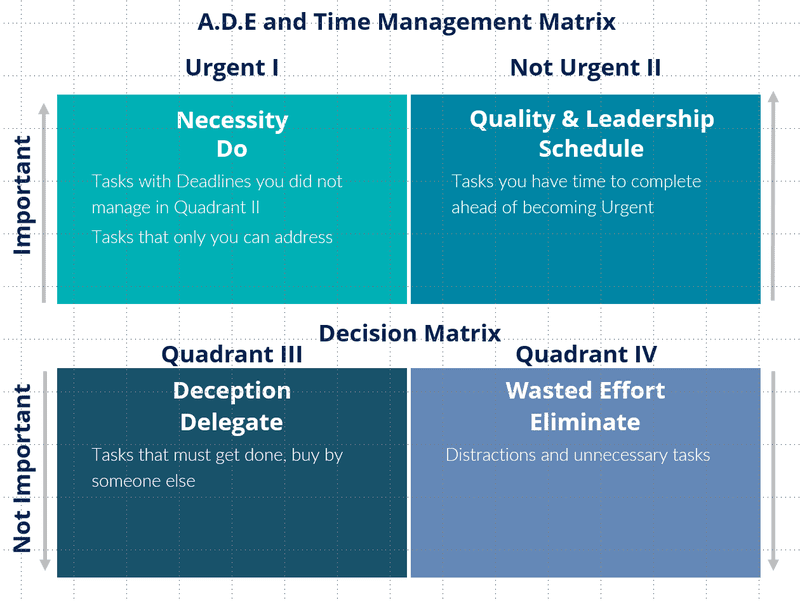
Utilizing Automate, Delegate, and Eliminate (A.D.E.) is a more dynamic approach to managing tasks. By integrating the principles of Automate, Delegate, and Eliminate (A.D.E.), you can streamline your workflow and maximize efficiency. Let’s explore how A.D.E. can be applied to each quadrant.
Quadrant I: Urgent and Important
Tasks in this quadrant often involve crises, deadlines, or pressing problems. These require immediate attention and cannot be ignored. However, not all urgent and important tasks need to be handled by you.
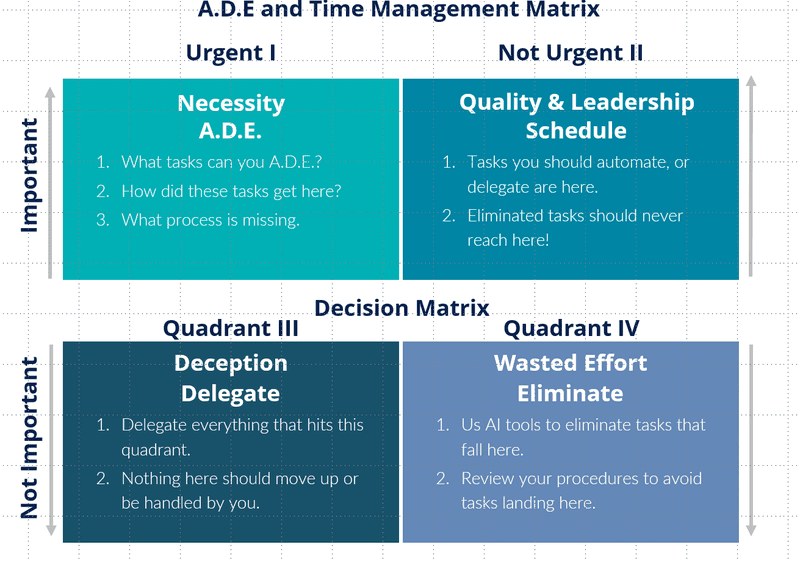
A.D.E. Actions
- Automate: Identify repetitive urgent tasks that can be automated. For example, setting up automated reminders for deadlines or using software to handle recurring processes.
- Delegate: If the task requires immediate action but doesn’t need your expertise, delegate it to a capable team member.
- Eliminate: While rare in this quadrant, some tasks may appear urgent and important but are unnecessary. Evaluate whether the task truly aligns with your goals before acting.
Adding A.D.E. to a Minddump and Time blocking practice will increase your efficiency and effectiveness.
Quadrant II: Not Urgent but Important
This quadrant is where long-term planning, relationship building, and personal growth occur. Emphasize spending more time here to prevent tasks from becoming urgent crises.
A.D.E. Actions
- Automate: Use tools to streamline important but non-urgent activities, such as scheduling regular check-ins or automating data collection for strategic planning.
- Delegate: Assign parts of long-term projects to team members who can contribute effectively, freeing up your time for higher-level focus.
- Eliminate: Periodically review your goals and eliminate tasks that no longer align with your priorities or vision.
Quadrant III: Urgent but Not Important
Tasks in this quadrant often feel pressing, but don’t contribute significantly to your goals. These include interruptions, unnecessary meetings, or minor requests.
A.D.E. Actions
- Automate: Set up systems to handle interruptions, such as email filters or automated responses for routine inquiries. Use AI to record notes and schedule tasks.
- Delegate: Pass these tasks to others who can handle them without compromising their own priorities. Consider remote workers to handle projects that fall into here.
- Eliminate: Ruthlessly cut out tasks that don’t align with your business model. For example, decline meetings that lack a clear agenda or purpose.
Quadrant IV: Not Urgent and Not Important
This quadrant is the realm of distractions and time-wasters, such as excessive social media scrolling or unproductive activities. Often, people get stuck in the tyranny of the urgent.
A.D.E. Actions
- Automate: Use apps that block non-essential websites during work hours. Avoid this quadrant.
- Delegate: Delegate all items that fall into this quadrant to someone else.
- Eliminate: Remove these tasks entirely from your schedule. Focus on activities that align with your goals and values. Stay in quadrants I and II.
Why A.D.E. Complements A Matrix
A matrix is excellent for categorizing tasks, but A.D.E. adds actionable strategies to manage them effectively. By automating repetitive tasks, delegating responsibilities, eliminating unnecessary activities, and combining this with mind-dumping and time blocking, you can free up time to focus on what truly matters. This approach not only enhances productivity but also reduces stress and improves work-life balance.
Conclusion
Using an effective Time Management Matrix provides a timeless framework for prioritization, but integrating Automate, Delegate, and Eliminate (A.D.E.) takes it to the next level. By applying A.D.E. principles to managing wealth, you can transform your workflow, focus on high-impact activities, and achieve your goals with greater efficiency. Start today by reviewing your tasks and asking: Can I automate this? Should I delegate it? Or is it time to eliminate it?
Advisory services provided by WMS-LLC, a dba of Balboa Wealth Partners, Inc, an Investment Advisor registered with the SEC. Advisory services are only offered to clients or prospective clients where Balboa Wealth Partners and its Investment Advisor Representatives are properly licensed or exempt from registration.


